
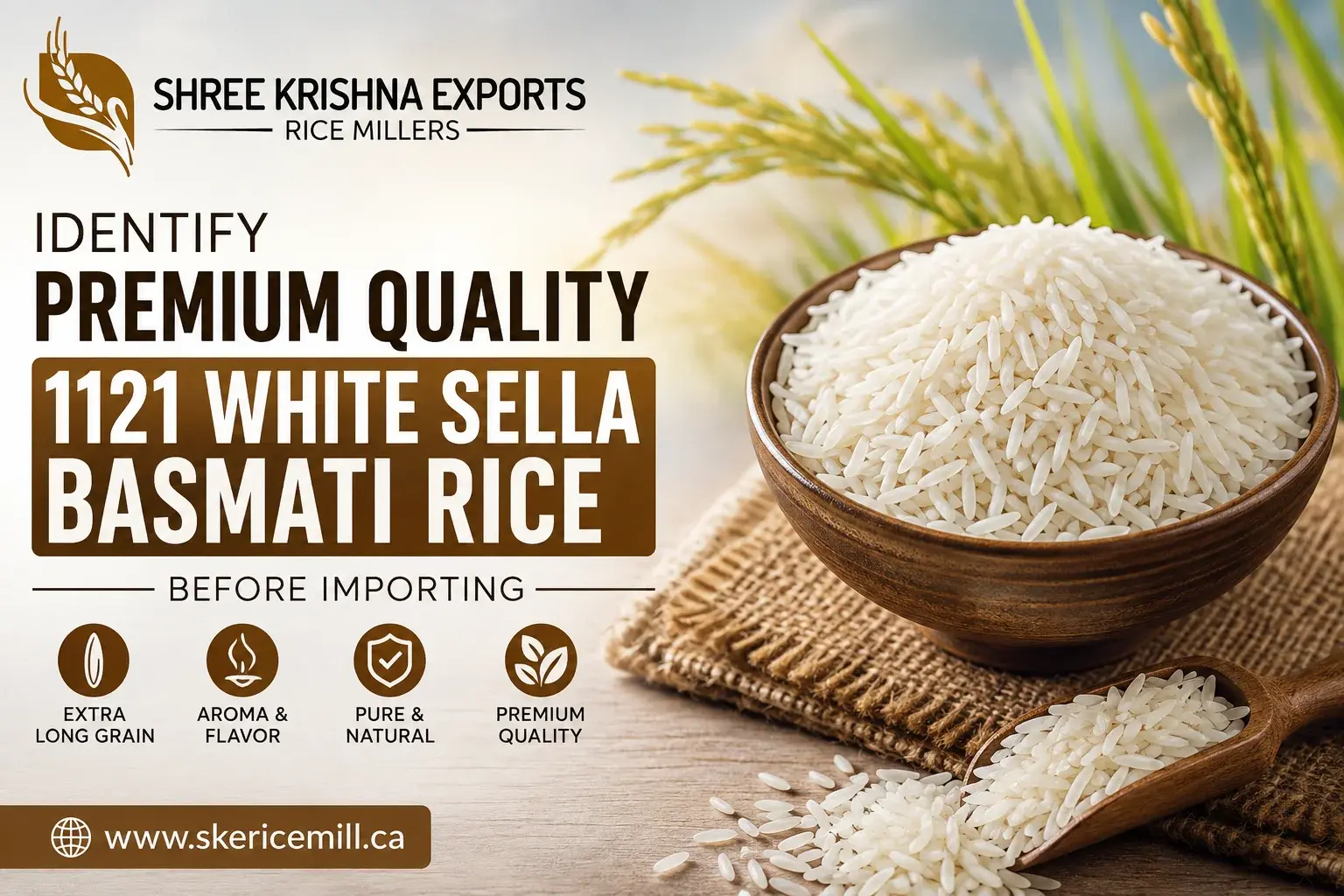
Importing 1121 white sella basmati rice requires careful evaluation because the quality of one shipment can directly influence customer satisfaction, business reputation, and repeat orders. For Canadian importers, wholesalers, retailers, and food service businesses, selecting the right supplier is important. And it begins with knowing how they can identify premium-quality rice before finalizing the basmati rice supplier.
Though product images may look similar, but the actual quality depends on several factors. That is why, in this blog, we are sharing a few factors that will help you identify the best quality 1121 white sella basmati with ease.
Inspect the grains visually
Always start with visual inspection to understand the quality they supply. This rice variant is known for its long, slender, and uniformly sized grains with a clean white appearance. Also ensure that the batch doesn’t consist of excessive broken rice, discolored grains, stones, dust, or other particles. Look for uniform-sized grains and ensure that they are properly graded before their packaging and supply.
Verify the quality of grains
Professional exporters provide a detailed product specification sheet before shipment. Instead of relying only on photographs, we recommend importers to compare the actual specifications of the 1121 white sella basmati rice shared by the exporter. Below, we have shared a table to help you know which all quality parameters you must consider.
| Quality Parameter | What Buyers Should Expect |
| Grain Length | Long and uniform grains suitable for premium markets |
| Broken Grains | Low percentage for better presentation |
| Moisture Content | Balanced moisture for safe storage and transportation |
| Purity | Clean rice with minimal foreign matter |
| Color | Natural white appearance with consistent grading |
| Cooking Performance | Long, fluffy, separate grains after cooking |
Test small sample for cooking
Visual inspection can only help your determine its outer appearance and quality. But the real test is all about how it appears and tastes after cooking. So, before placing a bulk order, ask the supplier for a sample and conduct a cooking test. The rice grains should elongate well, remain separate after cooking, and maintain its texture without becoming sticky. This simple evaluation helps buyers confirm that the rice matches the quality promised in the specifications.
Check certifications and export compliance
Reliable manufacturers maintain recognized certifications that show their commitment to quality and food safety. Importers should verify documents such as APEDA registration, FSSAI compliance, and ISO certified quality management systems. These certifications indicate that the rice is processed under established quality standards and prepared for international trade.
Get details about their basmati rice processing
Consistency is one of the biggest concerns for importers and to be rest assured about the same, knowing the process is a must. Ask the basmati rice manufacturer how they inspect every batch before export. Also ask them to share details regarding grading, cleaning, sorting, and packaging. It will help you know that each shipment maintains the same quality standards. Buyers must also confirm whether quality reports and product specifications are available for every order. This is to ensure that consistency is met in every batch you are ordering.
Do ask about packaging options
During international shipping, packaging protects the rice from moisture, contamination, and handling damage. Strong export quality packaging with proper labeling helps preserve freshness throughout transportation and storage. So ask if they use hygienic and high-quality packaging or not. Also, importers supplying Canadian retailers or distributors may also ask for customized packaging based on market requirements.
Conclusion
With the help of the factors we have stated above, it becomes easier to identify premium 1121 white sella basmati rice. Do not buy basmati rice only by considering competitive pricing, instead, ask manufacturers to share details regarding grain quality, technical specifications, cooking performance, certifications, supplier quality control, and export packaging as well. By carefully evaluating these factors, Canadian buyers can confidently source rice that meets the expectations of their customers. At Shree Krishna Exports, every batch of 1121 white sella basmati is processed, graded, and inspected with consistency in mind, helping importers receive reliable quality in every shipment.
FAQs – Frequently Asked Questions
Inspect the grain for uniform length, clean appearance, low broken percentage, and minimal impurities.
A cooking test confirms grain elongation, texture, aroma, and separation before placing a bulk order.
Importers should check APEDA registration, FSSAI compliance, and ISO certified quality management systems.
Uniform grains cook evenly, improve product presentation, and provide a consistent experience for retailers and consumers.
Shree Krishna Exports supplies premium 1121 white sella basmati rice with strict quality inspections, hygienic processing, export ready packaging, and dependable supply for buyers across Canada and other international markets.